
Felix Carter · 5 October 2026
Exploring How Resource Allocation Algorithms in Virtual Collectives Affect Long-Term Member Skill Development Trajectories
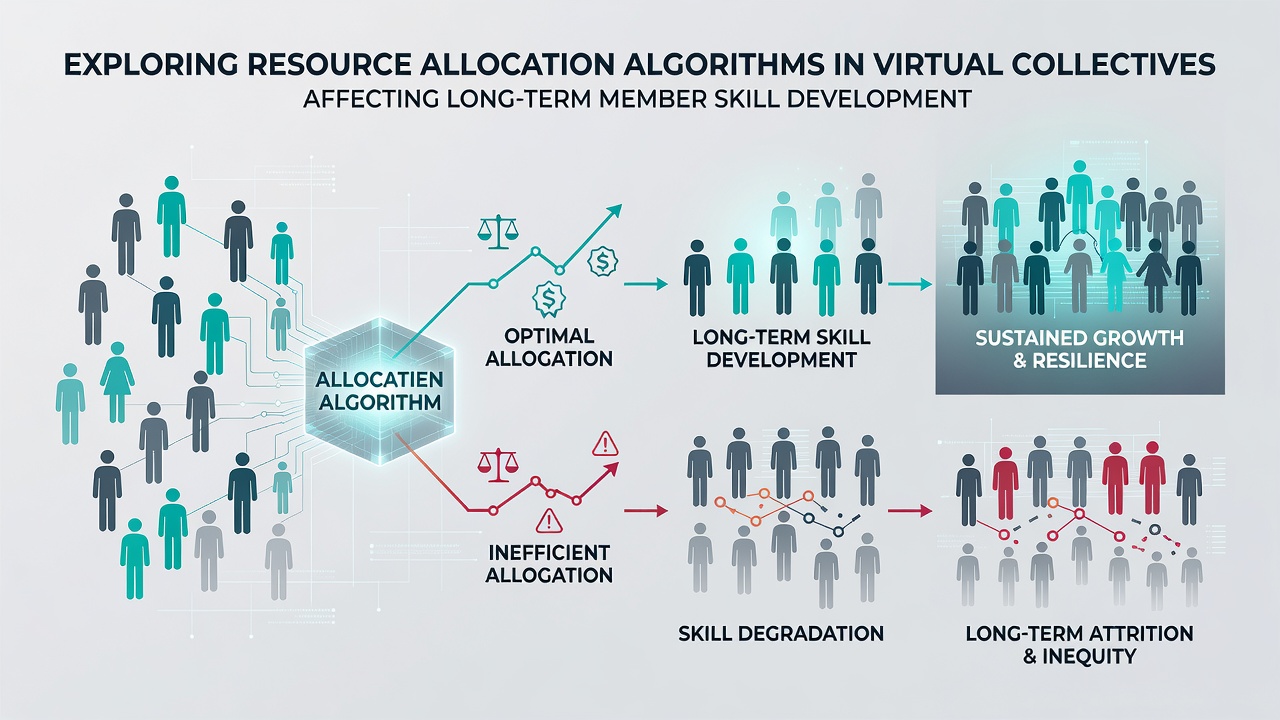
Resource allocation algorithms in virtual collectives determine how digital assets, opportunities, and collaborative roles distribute among participants, and these systems shape skill trajectories that unfold across months or years of engagement. Researchers tracking online communities have documented patterns where initial access rules influence whether members acquire specialized competencies or remain in generalized roles, and data from platform analytics in October 2026 continue to show measurable differences in long-term outcomes tied to allocation logic.
Core Mechanics of Allocation Systems
Algorithms in these environments typically evaluate member activity, contribution history, and group needs before assigning resources such as rare items, leadership slots, or training modules. Studies from multiple digital economy reports indicate that priority-based queuing favors consistent participants while random or lottery-style distributions create broader but shallower exposure, and both approaches produce distinct skill accumulation curves that researchers measure through contribution logs and competency assessments.
Priority Queuing and Specialization Paths
When systems reward sustained activity with repeated access to advanced tools, members develop deeper expertise in narrow domains because repeated practice compounds over time. Observers note that participants in collectives using this model often reach expert benchmarks in their assigned areas within twelve to eighteen months, whereas those in collectives with more fluid redistribution tend to accumulate a wider but less refined set of competencies across the same period.
Lottery and Rotation Effects
Randomized allocation introduces variability that forces members to adapt to new contexts frequently, and evidence from longitudinal platform data reveals faster cross-skill transfer under these conditions yet slower mastery of any single domain. One study revealed that rotation-heavy environments produced members who could pivot between roles more readily, although aggregate proficiency scores remained lower than in priority-driven groups after two years of membership.
What's interesting is how these mechanics interact with collective size and turnover rates. Larger groups with high churn require algorithms that quickly integrate newcomers, and this pressure often leads to simplified allocation rules that limit early-stage complexity and therefore constrain the upper bounds of skill development for those who stay longer.
Longitudinal Data Patterns
Figures released in October 2026 by the European Commission's Joint Research Centre highlight correlations between allocation transparency and sustained participation, showing that members who understand how resources are distributed maintain higher engagement levels and therefore accumulate more practice hours. According to European Commission research on digital skills trajectories, transparent algorithms correlate with steadier skill progression curves, particularly in collectives that publish allocation criteria and update them based on member feedback.
Canadian government statistics on digital economy participation further illustrate that collectives employing hybrid models, which combine priority elements with periodic resets, produce members whose skill sets remain adaptable while still allowing specialization. Data from Statistics Canada digital skills reports indicate these hybrid approaches reduce attrition among mid-level participants who might otherwise plateau when locked into early role assignments.
Interaction With Collective Governance
Governance structures that allow members to adjust algorithm parameters create feedback loops where observed skill gaps prompt rule changes, and researchers have recorded instances where collectives revised allocation weights after noticing stagnation in certain competency areas. Such adjustments often occur after six to nine months of operation, once enough longitudinal data accumulates to reveal trajectory divergences.
Take one researcher who noticed that collectives updating their algorithms quarterly maintained more balanced skill distributions across the membership base compared with those that left parameters static. The ball's in the collective's court once performance metrics become visible, and groups that respond to those signals tend to sustain broader member development over multi-year horizons.
Conclusion
Resource allocation algorithms in virtual collectives function as structural determinants of which competencies members develop and at what pace, with priority, lottery, and hybrid models each generating characteristic long-term trajectories. Data collected through 2026 continue to demonstrate that transparency, adaptability, and alignment between allocation rules and collective goals influence whether skill development remains narrow and deep or wide and flexible. Observers tracking these systems note that ongoing measurement of participation patterns and competency benchmarks provides the clearest evidence of how algorithmic choices translate into sustained member growth across diverse virtual environments.